
The massacre and destruction of Kostarazi
Short Description:
In the spring of 1944, the occupation authorities intensified their efforts to suppress the guerrilla groups in Western Macedonia. As part of this, on April 12, 1944, strong forces entered Kostarazi and engaged in mass shootings, violence and executions of civilians. During the operation, about 7 civilians lost their lives, while the settlement of Kostarazi was almost completely destroyed. The case of Kostarazi is yet another tragic testimony to the destruction caused by the war and the heinous crimes committed by the Nazi regime in Greece. In 1998, the Greek state declared Kostarazi a Martyred Village in honor of the victims of the massacre.
Photo gallery:
Detailed Description:
In the spring of 1944, the occupying forces intensified their operations to eliminate the guerrilla groups operating in the areas of Western Macedonia. In this context, the German garrison of Kastoria, which was part of the regional garrison of Florina, received information during an interrogation that Dimitrios Gavros or Gavropoulos, a miller from Kostarazi, was collaborating with guerrillas of the Greek People's Liberation Army (Ellinikos Laikos Apeleutherotikos Stratos / ELAS). Gavros, who had suffered the brutality of the occupation authorities in July 1943 when his house and two others in Kostarazi were attacked and burned, appears to have supplied the guerrillas with food and electricity to charge the batteries of their radios.
Based on the information gathered by the Kastoria garrison, the occupation forces in Thessaloniki issued an order to organize an operation to eliminate the guerrillas operating in the areas around Mount Askio. Sergeant Michael Ebner of the military gendarmerie was assigned to lead the operation. In connection with the Kostarazi case, the Kastoria garrison ordered the destruction of the mill of Dimitris Gavros and the arrest, dead or alive, of the miller and his transfer to the garrison.
On April 12, 1944, coordinated forces of the Wehrmacht, the SS, and Bulgarian Komitadjis launched an operation to pursue guerrillas in the Askio area. Sergeant Ebner moved towards Kostarazi with about 200 soldiers and 50 Komitadjis. The male population of Kostarazi, informed of the impending attack and aware of similar operations and massacres by the occupation authorities that had preceded it in other villages in Western Macedonia, abandoned the village and sought refuge in the surrounding forests.
When the occupying forces entered the village, the violence began. One of the first victims was a child, only twelve years old, who died under the fire of the invaders. On the orders of Sergeant Ebner, the civilians who had remained in Kostarazi gathered violently in the square. There, the sergeant demanded the immediate return of the residents who had fled, with special emphasis on the return of the mill owners, Dimitrios Gavros and Andreas Motsios. At the same time, he tried to reassure those gathered, assuring them that no violence would be used against those who returned to the village of their own free will. However, Ebner underlined the intentions of the occupation forces and warned that twenty residents would be executed in case of disobedience.
To ensure that the message was delivered to the fugitives, the military forces forced the villager, Dimitrios Tsitsis, to dress in white and go into the surrounding woods to deliver the threatening message. Despite assurances, when the villagers and mill owners returned, Sergeant Ebner executed Dimitrios Gavros with his service revolver.
On April 13, 1944, the occupying forces, continuing the work of destruction, proceeded to burn Kostarazi. The attack completely destroyed 261 houses and damaged 10 others. In addition, three elderly people and two infants were executed or burned alive. At the same time, the SS troops, setting up machine guns, prepared to execute the male population of the village. Sergeant Ebner claimed in his post-war testimony that it was his intervention that prevented the execution. In the end, about 78 men were taken hostage by the Kastoria garrison, who were released a few days later thanks to the intervention of the Prefect of Kastoria.
In general, in the massacre of Kostarazi, about 7 civilians lost their lives due to the violence of the conquerors, while the village's residential fabric was almost entirely destroyed. After the destruction, the inhabitants of Kostarazi were forcibly displaced and scattered to the surrounding villages, while the repopulation of the village was forbidden. In this way, the occupying forces chose to punish the civilian population for their support of the rebels. Kostarazi was yet another tragic testimony to the brutal destruction of the war and the merciless crimes committed by the Nazi regime in Greece.
In 1998, in recognition of this tragic event and as a tribute to the victims of the massacre, the Greek State declared Kostarazi a Martyred Village by Presidential Decree No. 399/07.12.1998.

Indicative Literature:
Δοξιάδης Κ. Α., Καταστροφές οικισμών, Αθήνα 1946.
Δορδανάς Σ.Ν., Το αίμα των αθώων. Αντίποινα των Γερμανικών Αρχών Κατοχής στη Μακεδονία, 1941-1944, Αθήνα 2007.
Υπουργείον Κοινωνικής Πρόνοιας. Διεύθυνσις Συντονισμού, Καταστραφείσαι πόλεις και χωριά συνέπεια του Πολέμου 1940-1945, Αθήνα 1946.
Related locations
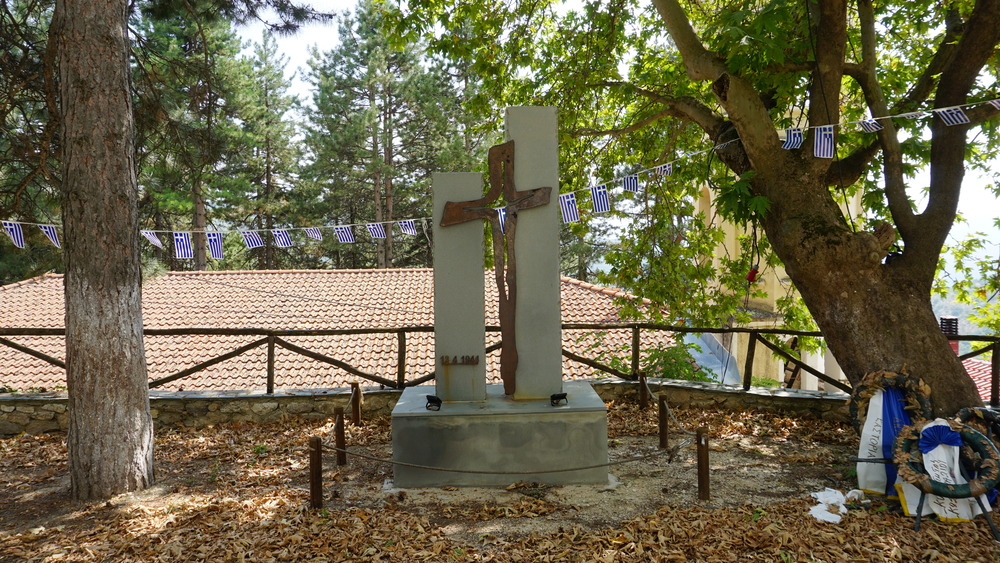
Monument to the massacre and destruction of Kostarazi
Monument to the massacre and destruction of Kostarazi