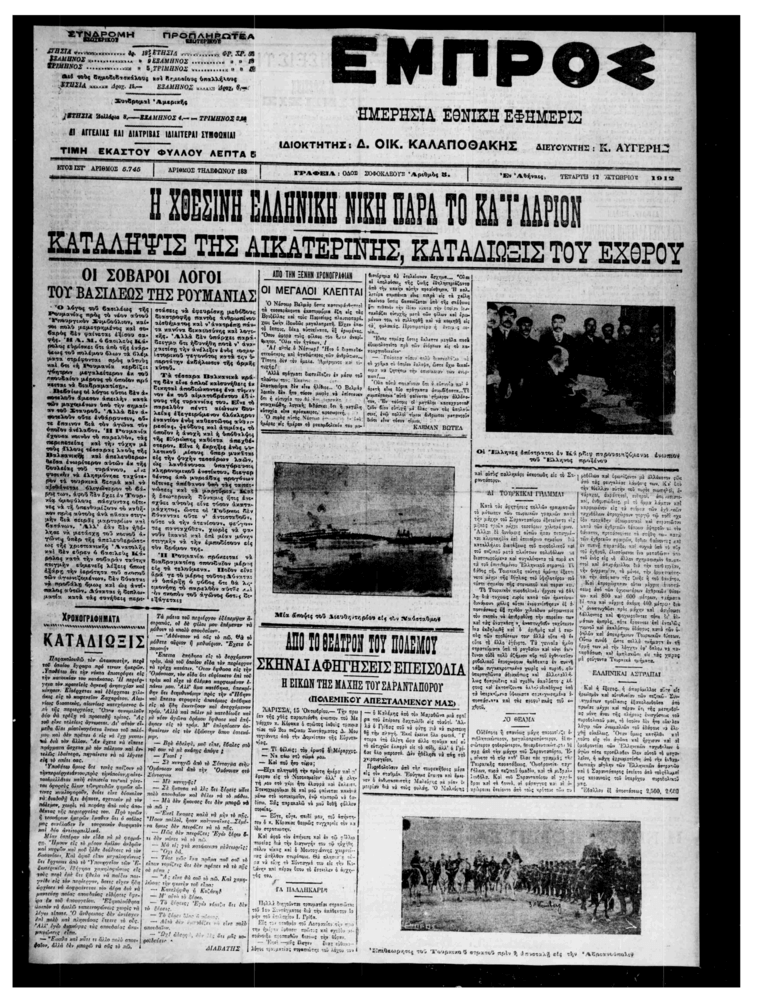
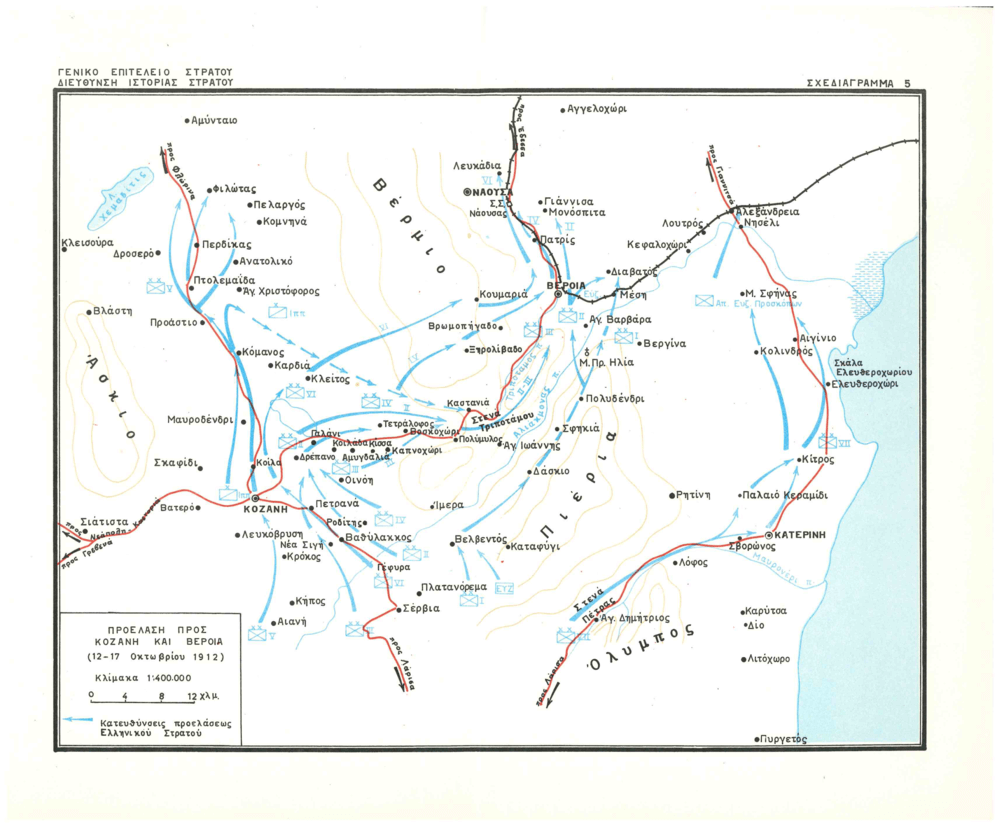
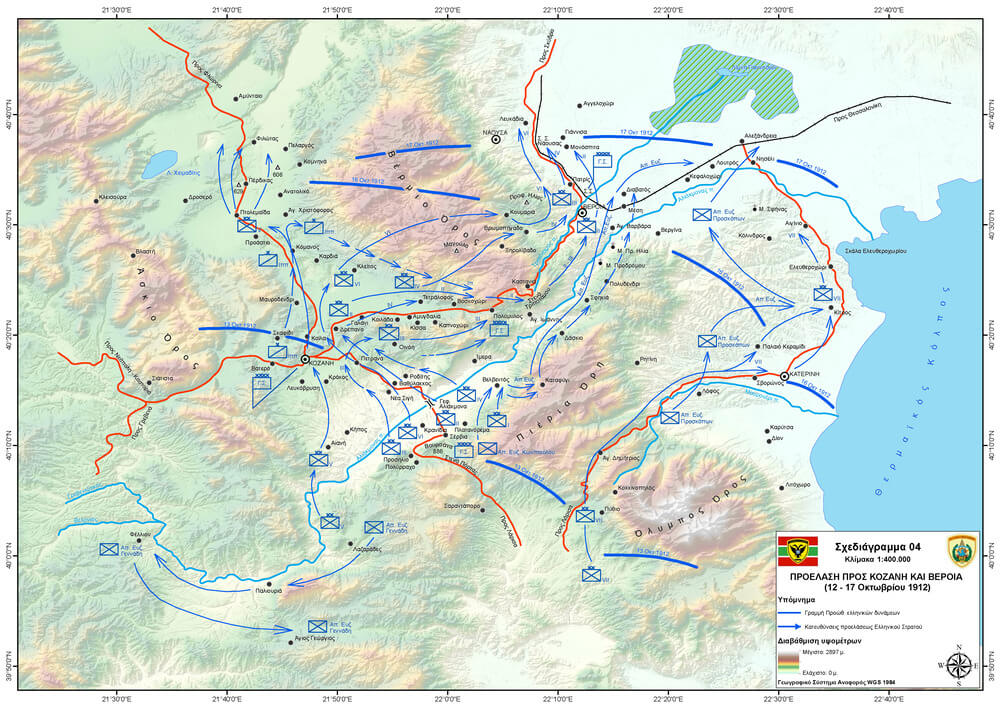
Following the capture of Servia and the crossing of the Aliákmon on October 10, 1912, the Greek army proceeded to advance towards the regions of modern-day Western and Central Macedonia. The I Division and Konstantinopoulos' Evzones Detachment were directed to proceed towards Veroia, while Divisions II-IV and VI were instructed to advance towards the north-west. On October 11, the Greek army invaded Kozani, and on the 13th, the headquarters of the General Headquarters were relocated there. Thereafter, the main body of the Divisions turned eastwards with the objective of capturing Veroia and advancing to Thessaloniki, which according to reports had become a target for Bulgarian forces.
A relatively small contingent of Greek forces, comprising the V Division, the Cavalry Brigade, and the Gennadis' Evzones Detachment, advanced in a westerly direction. This maneuver was designed to reinforce the defenses at the western end of the Thessaly Army and to assess the feasibility of capturing areas of western Macedonia, should the commander of V Division determine that such an objective was achievable. In accordance with orders from the General Headquarters, the Cavalry Brigade conducted reconnaissance missions on October 14 at Dorutlar (now Proastio) and Kailaria (now Ptolemaida). The Brigade observed the absence of Ottoman forces in these areas and subsequently returned to its base in the village of Komanos, having completed its mission.
The next day, October 15, the V Division started from Kozani and moved along the road first to Koila and then to Komano. The frost of that day forced the mounted soldiers to move on foot. At about 1530 hours, two batteries of the V Division, as well as the 22nd and 23rd Infantry Regiments, moved south of Kailaria. From the village of Dorutlar, the 9th Artillery Division attacked Kato Kailaria, where there was reportedly Ottoman artillery. At the same time, the two infantry regiments advanced from the south towards Kailaria and took up battle positions.
However, with the initial artillery barrage, a delegation arrived to proclaim the surrender of Kaillaria. That evening, the advance guard of the V Division entered the town, while the majority of the Division's forces spent the night on the south side. The subsequent objective of the Greek forces was to endeavor to breach the robust Ottoman defenses at Nalbankioi (now Perdikkas), with the objective of consolidating the Greek presence in Western Macedonia.